Millennial nostalgia bait: On Robin Klein's Melling Sisters Trilogy
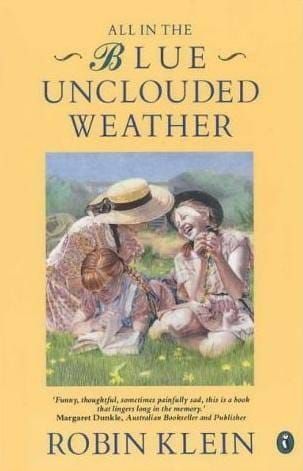
I loved All in the Blue Unclouded Weather (and its two sequels Dresses of Red and Gold and The Sky in Silver Lace) as a child. The first of the trilogy was released in 1991, when I was 8, so the series was tailor-made for a bookish kid with a strong interest in the past. I must have reread them endlessly, as I did with all my favourite novels back then (one day I will write about my twice-yearly rereads of everything L.M. Montgomery ever wrote).
Anyway, I haven't read them for a very long time, but was prompted to do so based on a conversation I had with a friend about the YA content on Radio National's recent (terrible) 100 Greatest Australian Books list. That list, like all such public vote-based lists, was absolutely dire, full of nostalgia bait, recency bias, and every predictable piece of middlebrow sludge that you would expect. The list was also, to nobody's surprise, incredibly white, with an embarrassing lack of First Nations writers, in particular.
While I was pretty down on the "I haven't read a book since Year 12" aspect of the list, as a card-carrying Elder Millennial, I am also susceptible to nostalgia. However, my chosen brand of Elder Millennial bait did not appear on the list. So I decided to reread them. You can only fight your generational tendencies for so long, and I do have a Cancer sun.
The Melling Sisters trilogy, which is themed around the seasons (summer, autumn, winter, at least), is set in a fictional rural Australian town called Wilgawa in the late 1940s. The Melling sisters - Grace, Heather, Cathy and Vivienne - are poor, with an absent-minded but affectionate mother, and an entertaining, but also frequently absent, father. The decision to focus on four girls obviously evokes the March sisters of Little Women, but in this case it is the youngest sister, Vivienne, who is the emotional heart of the series. Their cousin Isobel, who loves movies (and introduced me to Veronica Lake's hairstyle) and lying, is also a frequent and very funny visitor. What I hadn't really remembered about the novels is that they are very episodic. Each chapter functions essentially as a short story, although there is a loose arc to each novel. I haven't read these novels for about 20 years but I found myself remembering the twist at the end of almost every chapter.
Dear reader, they hold up! There are certain aspects of the novels that trouble me, which I will get to shortly. Certainly, Klein's representation of rural Australia is highly idealised, but not entirely fantastical. Their town, Wilgawa, is physically beautiful, although certainly very run-down. It is a hard life - shoes are passed down from sister to sister, regardless of whether they fit, everything is a bit old and patched together, and food is hardy plentiful - but it is also a cosy and loving world. The novels are supposed to make you feel good. Almost every chapter ends on some kind of emotionally satisfying note. The references to 1940s films are also meant to be highly nostalgic: these girls live in a world where American movie stars provide the only source of real glamour. I loved old movies as a kid (and still do), and these novels may have been one of the things that nudged me in that direction.
Like the best children's fiction, however, the novels also feature moments that speak to adults perhaps more clearly than they speak to kids. The town's poorest family, the Gathins, are a case in point. The Melling girls do not want to associate or be associated with the Gathins, even though the Mellings seem to be almost as poor as the Gathins, especially in the third book. The key is Mrs Gathin; we are told that there are "numerous" Mr Gathins, and that perhaps each child is borne of different father. Is she a sex worker? I certainly thought so on this reading. Klein gives you just enough of the eldest girl, Phyllis, to enable you to see that she's smart and kind and interesting, but she also knows that this isn't enough to make the Mellings want to be friends with her.
There is also an old woman who reappears a few times who remembers having a love affair with an "Indian prince" (I won't spoil what is revealed about this later). That's also the first and only time that somebody of a different race plays a role in these novels. Indigenous people are also totally absent from this world. I wasn't savvy to this in the 90s, both because I was a child and because we weren't taught much about Australia's Indigenous history, but now it stands out to me very starkly as a real missing piece of this otherwise very realistic portrait of Australian rural life.
And that brings me to the point that I kept coming back to on this rereading. These books are very, very sad. Sure, the Melling sisters are plucky, fun, friendly, and obviously know how to make the best of a bad situation. But Klein doesn't hold back in position the reader to see the tragedy of their batty absent-minded (but very endearing) mother pushed to the edge of poverty, and Grace in tears when she has to beg a relative to let them move in while they wait for their Housing Commission flat. One of the smartest chapters in the third novel, The Sky in Silver Lace, sees Mrs Melling come undone completely, until a conversation with an old friend revives her somewhat.
Another aspect of the novels that leapt out to me on this reading is the portrait of Mr Melling. He is described as loud, swear-y, frequently drunk, and some kind of madcap inventor. However, what Klein also allows us to see is that he is profoundly traumatised by war. He hijacks excursions to visit the town's War Memorial, and is fanatical about his children and their friends showing appropriate respect. He is also very careful about what happens to his few mementos of war (I should clarify here that he fought in World War One, not Two). He also (spoiler!) completely abandons the family in the third book. Again, these books are much darker and sadder than I remembered. How much of Mr Melling's erratic behaviour is due to unprocessed World War one trauma? Probably a lot. The novels both allow you to see that he is highly troubled, but also doesn't let him off the hook.
The third book, The Sky in Silver Lace, actually stood out to me the most on this rereading, as Klein does such a good job in articulating just what the sisters have lost in their move from the fictional Wilgawa to the city (I presume it's meant to be Sydney, but it's never named as such and it's not very specific about landmarks). There's something much more squalid and sad about their life in the city. There are also opportunities, of course, for all the girls, especially Grace and Heather. But the gap between the sisters' imagination of the city and the actual city is very cleverly rendered. And the ending of that novel is very, very sad and quite elegiac (despite the promise of spring), which is quite a radical decision for Klein to make given that that is where we leave the girls: on the edge of adulthood, newly aware of how adults (and life) can let them down.
I'm also wondering, too, if these novels are part of the reason why I ended up specialising in historical fiction. Probably, but I also blame Rilla of Ingleside.
Anyway, Robin Klein is tremendously underrated and if you're going to indulge in nostalgia bait, choose these and not Marsden's "but what if the Chinese invade" novels!