On funny historical fiction: Jo Harkin's The Pretender
Historical fiction is not funny.
Of course, that's a generalization; the kind of sweeping statement that I constantly tell students not to make. However, it's also kinda true, with one caveat: most historical fiction is not funny.
When I teach my Historical Fiction unit, one of the bits of feedback that I receive is that a lot of the content is quite heavy. There's death, suffering, sexual assault, slavery, racism etc etc. My response to that critique has been twofold. I dedicate one week to historical comedy on the screen (students can pick their own text). I also point out that writing about the past means, often, representing bad things: the past wasn't this lovely landscape of pretty dresses and handsome men. It's inevitable that you have to write about hard, bad, difficult things. That's true of all literature, not just historical fiction.
Historical comedy on the screen, as I cover in my unit, has long been a thing, stretching all the way back to Charlie Chaplin and Buster Keaton movies. Everybody's dad recommends that they watch Monty Python, or so my students tell me. And, more recently, there's so many good examples of historical comedy on the screen: The Great, Our Flag Means Death, Gold Diggers, History of the World: Part II, and my personal favourite, Dickinson.
I've written a lot about historical comedy on the screen, and I almost always enjoy it as a genre. Lately, I'm loving the YouTube series Abigail's Divine Comedy; a comedy about Abigail Williams (of The Crucible fame) and her sidekick, Satan. Just trust me; it's amazing and very silly. However, lately I've been wondering why we so seldom get historical comedy on the page. Of course, that's a generalisation, but I do think comedic historical fiction is still a comparative rarity.
A couple of years ago, a student commented to me that they had only recently realised that people in the past laughed. It would be easy to write that comment off as a typically wacky thing that students like to say, but I think it was actually a really insightful comment. I think what that student was actually getting at is that we are conditioned to think of the past as this weighty, serious time where people did serious things and thought serious thoughts. We are used to having history presented to us that way and, perhaps, we have seen too many photos of grim-looking, unsmiling ancestors looking straight at us very seriously. That people in the past could be silly, tell jokes, and simply laugh strikes us as incongruent, and almost faintly disrespectful at times. I think we also have a sense of history as overwhelmingly grim: people died young, there was a lot of suffering, a lot of warfare etc. We seldom think of the past as fun or silly.
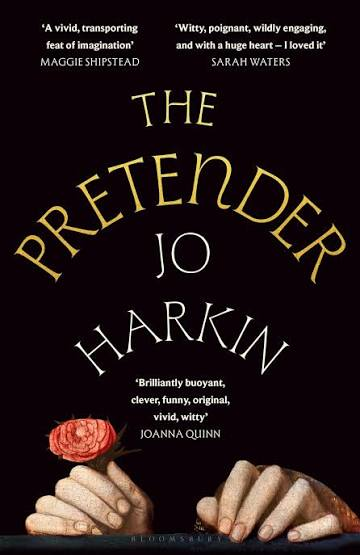
I've been reading Jo Harkin's The Pretender, about one of the pretenders to the throne of Henry VII: the man known to history as Lambert Simnel. Simnel claimed to be Edward Plantagenet, the son of the Duke of Clarence, and thus the first cousin of one of the famed Princes in the Tower (the sons of Edward IV, who were possibly killed by Richard III, I SAID POSSIBLY SO RICARDIANS PLEASE LEAVE ME ALONE). Simnel was the figurehead of a Yorkist rebellion that obviously did not succeed because Henry VII was followed by Henry VIII, wife-beheader. The story of Lambert Simnel is quite interesting in its own right, and I won't spoil you now, as much as you can be spoiled about a historical figure that lived 500 years ago. There are a lot of very earnest engagements with the story of the Princes in the Tower, and various historians and writers have claimed to have solved the mystery of who killed them. Of course, we will never know, but people do love to have their fun. I have no interest whatsoever in wading into those waters, however (except I totally think it was Richard III).
Anyway, the novel begins with the child who would become Lambert living under the name John Collan. And the novel is deeply, truly funny. I knew that I was going to love it from the beginning of the second chapter, when John/Lambert's village is greeted with the news that Edward IV has died:
King Edward is lateward dead.
'Deadward,' says Jennott (7).
Okay, that's an obvious joke, but I never claimed to have a sophisticated sense of humour, and that line made me laugh aloud. What's so great about it is that it is so unexpected and silly. That spirit of fun pervades the entire novel. John's most significant nemesis, at least at the opening of the book, is a goat called Gaspard. Jennott, the family's sweary maid, is also a great comic character:
"Those two boys will never get of that tower," Jennott says. "And Lord Protector Richard will make himself king. I've seen his type before."
"What type?" Will says.
"Men," Jennott says (14).
The life-and-death drama of the dying days of the Wars of the Roses is simply fodder for comedic speculation for the peasantry...at least, until a mysterious nobleman arrives at the Collan door.
Of course, as matters proceed, things become more serious for poor young John/Lambert/Edward. He is separated from all he knew, and thrust into situations that he truly cannot comprehend or process. I'm not going to quote extensively from the book, because many of the lines are laugh-out-loud funny and I don't want to spoil them for you. What Harkin does so brilliantly is create empathy for her main character through her use of comedy: this is a young boy, full of all the foibles and anxieties of any teenager, who has no real idea what he's in for. Of course when he becomes a nobleman his biggest preoccupation is how to talk to hot girls at court. He's thirteen. That's not to say the book is not sad; there are some scenes that are just brutally sad, especially when John/Lambert/Edward has to grapple with all that he has lost. Harkin has a wonderful light touch, however; she pulls back just where other writers would lay on the drama.
The idea that history is simply a story about a bunch of very silly people just sort of bumbling about trying to do their best - in the same way that we're all very silly people just sort of bumbling about trying to do our best - is not the way we've been conditioned to receive historical stories. There are other comedic takes on the life of Lambert Simnel; there's a great Horrible Histories sketch about it, which is a parody of Who Do You Think You Are. However, as somebody who has read more Tudor historical fiction than most (I wrote a whole book about it), I can tell you that the Tudor period is mostly treated as a violent, dramatic soap opera, marked by politics, and full of life and death stakes.
Anyway, The Pretender ends up being a very sad novel about a boy whose entire life is weaponised and exploited by those who are operating out of pure self-interest. As the novel goes on and John/Lambert/Edward (I'm going to use all these names because the issue of names, and the protagonist's identity, is a major plot point in the novel) becomes a man, the novel becomes far darker and more about grief, revenge and regret. However, the novel is also a reminder that historical fiction is about the full range of experiences in the past - not just the dramatic and the tragic, but the ridiculous, silly, mundane and the everyday. So give me more funny historical fiction, please.